




Helping industry work together more effectively to speed up innovation and maximise the benefits derived from new technology.
…with urgency and pace
…accepting, understanding and managing risk, and
…while minimising the demand on resources
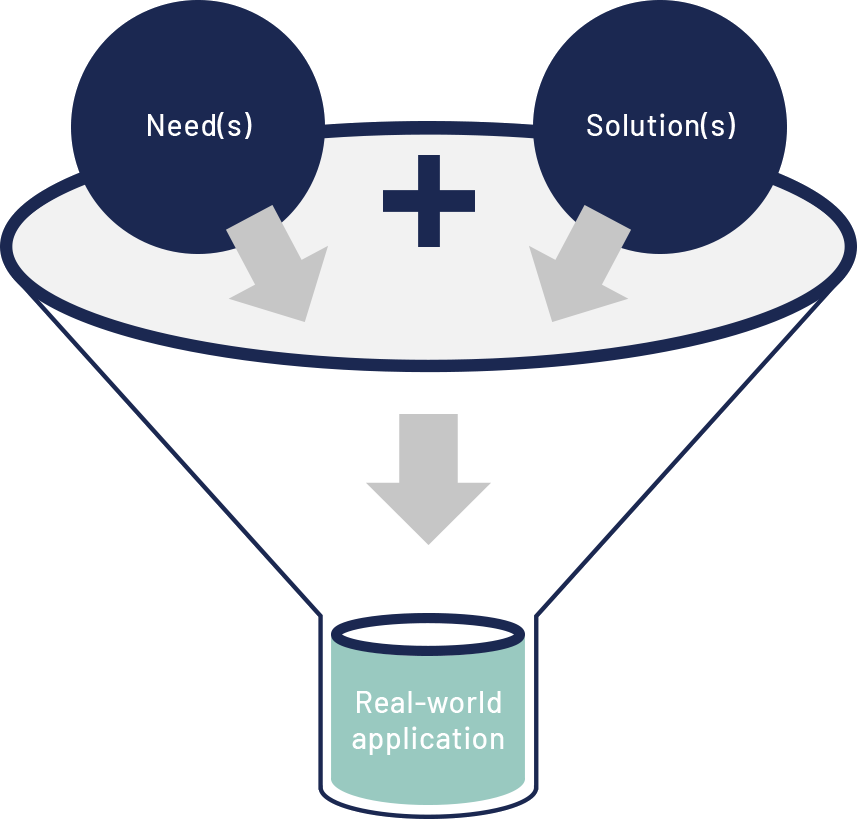
Any innovation should address an identified need.
A solution that is either completely new or novel in its application.
Actual change on the railway with a positive impact.
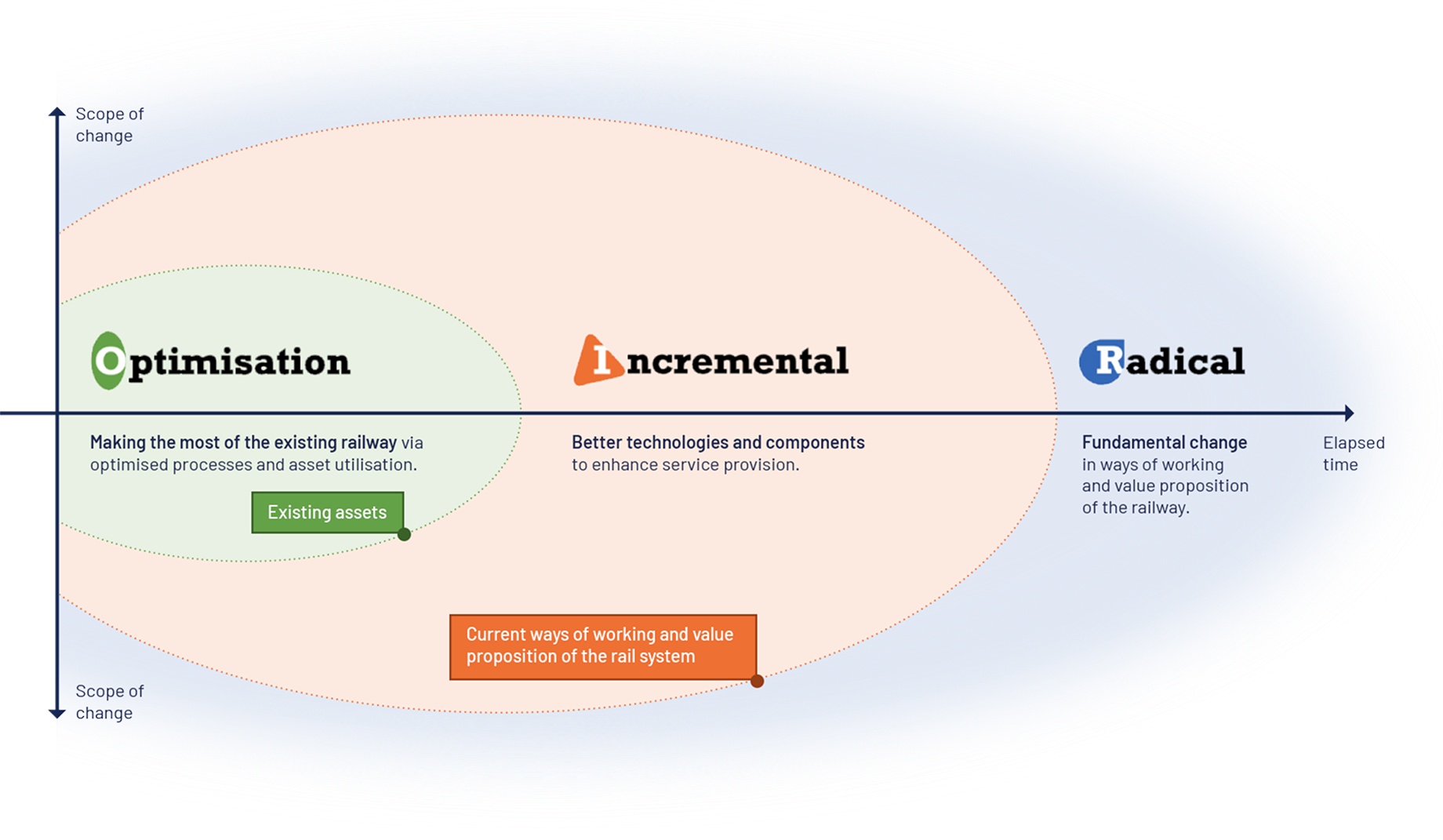
There are many ways to categorise innovation. The following categorisation is based around the scale and nature of change being made.
To succeed innovation requires team effort and clarity of roles. Organisations, and individuals within them, may have multiple roles to play, or perform different roles in different innovation journeys. It might also not be clear who can fulfil a role. Knowing strengths, weaknesses and gaps in the ‘innovation team’ relevant to what you are working on is vital.
Coordination that can speed up innovation and maximise the overall value derived from investment in innovation.
Role:
– Determine, with challenge owners where innovation is needed, and communicate these needs to the right audiences.
– Identify with R&D funding agents where market forces will address challenges and needs, and where they cannot.
– Consider the mix of mechanisms best suited to deliver different solutions, and support R&D funding agents in pursuing them.
– Work with buyers and adopters to ensure innovation has buy-in and is planned for.
– Support solution developers by defining pathways and linking them with the right organisations and roles.
– Support and capture lessons from early deployments.
Organisations within and beyond the rail sector allocating and prioritising public or private money to rail research, development and innovation.
Role:
– Ensure funding is spent in an effective and efficient way.
– Public funders: deliver for the public good and derisk / unlock solutions that wouldn’t be possible otherwise.
– Private funders: secure a competitive advantage that returns profit to investors.
People that run the railway, and have direct experience of how things are done, and the challenges and opportunities that result from the current ways of working. The organisations these people work for will usually benefit (directly or indirectly) from introducing changes.
Role:
– Define business needs.
– Steer the development of new solutions and champion their adoption.
Entities that are able and/or required to approve the solution on the operational railway.
These can range from academia to supply chain. Research institutions working in conjunction with start-ups and Small to Medium Enterprises (SMEs) can be a powerful accelerator for new solutions.
Role:
– Apply new thinking to address challenges and explore the art of the possible.
– Fully develop, prove and scale new solutions.
Organisations that will purchase and/or allocate resources required to implement the solutions. May not always be the organisations that own the challenge and derive direct benefit from addressing it.
Role:
– Make sound investment decisions proactively manage the complexity and risk of roll-out, and consider a range of time horizons.
– Understand the operational arrangements post-introduction by working with the adopters if not the same organisation.
Organisations in the rail sector that will operate and potentially maintain the solutions. May not always be the buyer or the organisations that will derive direct benefit from the adoption of new solutions.
Role:
– Provide input at the development stage by providing knowledge of real-world application.
– Ensure deployments go hand-in-hand with skills and processes to deliver change successfully.
Coordination that can speed up innovation and maximise the overall value derived from investment in innovation.
Role:
– Determine, with challenge owners where innovation is needed, and communicate these needs to the right audiences.
– Identify with R&D funding agents where market forces will address challenges and needs, and where they cannot.
– Consider the mix of mechanisms best suited to deliver different solutions, and support R&D funding agents in pursuing them.
– Work with buyers and adopters to ensure innovation has buy-in and is planned for.
– Support solution developers by defining pathways and linking them with the right organisations and roles.
– Support and capture lessons from early deployments.
Having defined the three broad types of innovation, it is useful to consider the differences between them, and what it means for the roles and responsibilities.
Technical novelty vs application novelty
Existing solutions applied in broadly existing ways.
Typical investment return timeframe
6 to 24 months with zero or limited further investment.
Risk of failure
Low failure risk – established ways of working and assets.
Return on investment
Medium to high benefit-cost ratio.
Proportion of rail specific efforts and funding
Must be driven by rail specific knowledge and relies on funding from within the industry.
Examples
– Rationalisation of differential speeds
– Optimisation of driving policies

Technical novelty vs application novelty
Evolved technology deployed in similar and slightly changed ways.
Typical investment return timeframe
2 to 5 years, with introduction often linked to to asset replacement or renewal windows.
Risk of failure
Medium failure risk, with a medium Benefit-Cost Ratio.
Return on investment
Medium benefit-cost ratio
Proportion of rail specific efforts and funding
Benefits from access to rail specific knowledge efforts. Able to use resources and funds wider than rail specific ones.
Examples
– Double variable rate sanders
– Lightweight modular, low cost, rapid-install rural footbridges

Technical novelty vs application novelty
Completely new technology utilised in completely new ways.
Typical Investment return timeframe
5+ years from completion of the initial research.
Risk of failure
High failure risk – other solutions emerge / funding troughs / many unknowns to resolve.
Return on investment
High benefit-cost ratio
Proportion of rail specific efforts and funding
Leveraging efforts across other modes and industries is essential.
Examples
– Application of interter technology in vehicle suspension
– Fault-tolerant track switches