ACADEMIC CAPABILITIES

Nottingham University

Resilience Engineering Research Group – Civil and Manufacturing


Overview

A modelling group specialising in predicting the causes of failure in engineering systems and identifying how these occurrences can be minimised or the consequences mitigated, through effective design, maintenance, and operation.
Extension to resilience – management of disruption and system restoration.
Three main themes:
Risk and Reliability – predict frequency of failure, find alternative design, maintenance strategies, optimisation with limited resources
Asset Management – predict asset degradation, optimise life cycle cost
System Complexity – modelling network resilience

UKRRIN status

UKRRIN member

Member of the Centre of Excellence in Infrastructure (CEI)

Member of the Centre of Excellence in Rolling Stock (CERS)

Resilience Engineering Research Group - Civil and Manufacturing - Test facilities

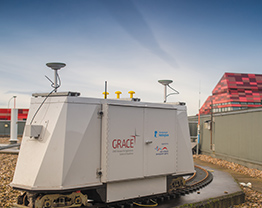
Dynamic captive test platform ; 120 m roof top truthing test track (train travels at 7 km/h) ; precision location system calibration ; multi-signal collection and integration ; interference assessment/ Full-scale 3-sleeper rig with automated tamping facility ; Large Triaxial Test rigs ; numerous smaller-scale ballast testing facilities/ National Centre of Excellence test facilities ; composite modelling ; manufacture ; mechanical testing ; inspection ; measurement/ The dedicated laboratory space (1750 m2) ; prototype electrical machine manufacture ; facilities for power device packaging ; dedicated electronic supplies ; emulation of variable frequency generation systems (up to 270 kW) ; dynamometers (800 kW at 1500 rpm to 49 kW at 120,000 rpm) ; €2M HVDC laboratory for the demonstration of Smart Energy Control and DC Grid Technology (Alstom Grid Centre of Excellence in VSC-HVDC) ; Proof-of-concept demonstrators/ Mode stirred chamber; GTEM Cell#; Anechoic chamber; 3D EM field scanner (2 independently moving probes)/

Research themes

Topic: Geomechanics
Summary:

Expertise includes constitutive and numerical modelling, micro-mechanics, shakedown theory, particle fracture and laboratory testing, means the centre is uniquely placed to apply its expertise to the solution of transportation geotechnics problems.

A large Railway Test Facility has been designed and commissioned for the repeated loading of full-sized sleepers embedded in ballast over subgrade. A variety of ballasts, including those reinforced with geogrids, are studied using it. Discrete element modelling is used to complement the research and provide insight into material behaviour. The Facility has been upgraded as part of the EPSRC Track 21 Project to study the effect of sleeper type, reinforcement, ballast type and the use of under-sleeper pads on performance.

A bespoke large triaxial system is used for testing ballasts under a range of stress conditions. Laboratory wheel-tracking tests on model pavements have been used to gain data on the permanent deformation of pavements and railway foundations.

Project examples: EPSRC Track 21 Project: Railway Track for the 21st Century
Topic: Risk and Reliability Engineering
Summary:

The centre is dedicated to conducting research into developing modelling techniques to predict ways of improving the design, maintenance and operation of engineering systems in order to reduce the frequency and consequences of failure. It is also committed to providing education in risk and reliability methods

We aim to produce models which predict the deterioration mechanisms and rates for the diverse range of assets which make up a modern railway system. These include the track, signalling systems, electrification systems, and communications systems, in addition to the civil structures such as bridges, tunnels and earthworks. Once the asset deterioration processes are understood, models can be produced which integrate the degradation with the effects of the possible interventions. By embedding the resulting asset state models into an optimisation framework, the selection of intervention activities and the time at which they are performed can be predicted to minimise whole life costs.

Project examples: Track maintenance decision making / Railway bridge asset management / Next Generation Prediction Methodologies and Tools for System Safety Analysis / Intelligent prognostics and Health management in Composite structures
Topic: Electromagnetic
Summary:

Capabilities include the measurement and characterisation of fields and the development of advanced simulation software. These can be uses in a number of contexts including wired communication channels and next generation wireless technologies (5G and on chip)

Project examples: ACCREDIT / ICENITE / Intelligent Sustainable Environments for 6G Wireless Networks
Topic: Electrification
Summary:

Capabilities include Reliability and health management of electrical systems: Technologies and methodologies, Energy Management: Smart grids expertise and energy storage and Power Conversion: Power device packaging and integration. These capabilities will help to meet challenges such as adopting smart grid technologies and improving electrification protection and control. Our Heat Transfer Research Group undertakes research on heating, ventilation, air-conditioning, refrigeration and heat transfer encountered in trains. We also have a growing capability in the traction sector working with a number of industrial partners

Project examples: Alstom Grid Centre of Excellence / Cummins Innovation Centre / DER Midlands Innovation Centre
Topic: Light Weighting
Summary:

The Polymer Composites Research Group at Nottingham is one of the leading international research groups in the field of processing and performance of polymer matrix composites, having expertise in both thermoset and thermoplastic matrices. The group conducts fundamental and applied research on manufacture and performance of advanced fibre reinforced composites. The group is also the coordinator of the EPSRC Innovative Manufacturing Research Centre in Composite Materials.

All these technologies are relevant for light-weighting solutions to railway carriages or sub-assemblies, where heavy metallic components can be replaced with lighter composite materials. New manufacturing techniques can allow unit costs to be more competitive and new materials and advanced structures can provide opportunities to integrate other functionality into the design. The group has active collaborations with a large number of companies across the transport sector and sees considerable scope to apply these techniques to the rail sector.

Project examples: Advanced Composite Integrated Structure / Fire Resistant Biocomposites for low environmental impact mass transit / ProPound / The Design of a Lightweight Composite Railway Axle
Topic: Scheduling
Summary:

The Automated Scheduling, Optimisation and Planning (ASAP) research group carries out multi-disciplinary research into mathematical models and algorithms for a variety of real world optimisation problems.

Capabilities include:

Modelling the complexity and uncertainty inherent in complex, real-world problems across a wide range of application areas including airport optimization, network routing, personnel scheduling, production scheduling/rescheduling, public transport optimization, space allocation, transportation logistics optimization and vehicle routing.

Project examples: OPTIMISED / Value Enhancement for Data from Assets and Transactions (VEDAT) / Automated Intelligent Decision Support Using Hyper-Heuristics
Topic: Control, Command and Communication
Summary:

The Nottingham Geospatial Institute (NGI) is one of the world’s largest academic centres in the field of navigation, sensor integration and data dissemination and display.

Our expertise can assist in maximising the efficient movement of passengers and freight on the railway, via accurate real-time train position data.

Areas of expertise include: Navigation Guidance and Control, GPS, future satellite systems (including Galileo), Inertial Navigation Systems, optimised position orientation, and integration with awareness of rail requirements.

Key Competencies:

GNSS (GPS and Galileo), Independent simulation and testing of GNSS and other positioning systems, Fixed test-track for system testing and research and development, Applications of GNSS positioning and navigation in the transport sector, Coordinate systems and map projection expertise, Precise deformation monitoring, Remote measurement techniques (such as airborne, terrestrial and satellite photogrammetry and remote sensing)

Project examples:

Resilience Engineering Research Group – Civil and Manufacturing – Fact File (2026-27)

13 Research staff

16 PhD students

3 Masters students

26 Publications

Capability matrix

CAPABILITY
CAPABILITY LEVEL
Easy to use for all
Accurate, accessible and understandable real-time information
Smart fare collection
Accessible to all
Multi-modal integrated journeys
Reliable and fast on-board connectivity
Freight friendly
Increased network access for freight
Safer freight operations and better asset management
Enable greater intermodality and access for freight customers
Greater asset utilisation and reduced freight journey times
Low carbon freight and On Track machines
Low emissions
Efficient new electrificaiton
Zero carbon self-powered vehicles
Low carbon freight and On Track machines
Intelligent energy management
Cleaner air
Quieter railway
Lowering embodied carbon of key material
Optimised train operations
Infrastructure and train capabilities to overcome capacity constraints
Simpler and safer real-time operations and decisions
Improved recovery from incidents and disruptions
Reliable and flexible train planning
More affordable solutions for lower-use lines
Efficient and reliable - infrastructure
“Right-time” actionable insights on infrastructure conditions
Efficient, effective and safe infrastructure maintenance
Improved resilience of infrastructure to climate change and extreme weather events
Speed up and de-risk introduction of infrastructure assets
Proactive management of infrastructure obsolescence
Efficient and reliable - rolling stock
“Right-time” actionable insights on rolling stock conditions
Efficient, effective and safe rolling stock maintenance
Improved resilience of rolling stock to climate change and extreme weather events
Speed up and de-risk introduction of rolling stock assets
Proactive management of rolling stock obsolescence
Efficient and reliable - interfaces
Improved vehicle/track interaction
Improved pantograph/overhead line interaction
Improved utilisation of constrained space
Improved whole system resilience
Data driven
Advanced computing
Advanced data analytics techniques
Data governance and standardisation
Data integration
Effective innovation culture
System and network models
Pro-innovation legal and regulatory frameworks
Testing, homologation, cross acceptance
Technically talented workforce
Job design and human performance
Workforce development and training
Safety and health
Safety assessment and evaluation
Cyber security
Fitness for duty and health assessment
Competitiveness
Demand forecasting
Cost modelling
Social value

Education and Professional Development

Undergraduate Courses

Civil Engineering B.Eng

Manufacturing Engineering (with an optional year in industry) B.Eng

Electrical Engineering and Renewable Energy Systems B.Eng


Postgraduate Courses

Civil Engineering: Structural Engineering MSc

Civil Engineering MSc

Engineering Surveying with Geographical Information Science MSc

Power Electronics and Drives MSc


PhD opportunities

Yes

Continuing Professional Development (CPD) Courses

Tailored CDP courses by subject, with various lengths.

Research Group key contacts

Name: Dr Rasa Remenyte-Prescott, Associate Professor in Risk and Reliability Engineering, Faculty of Engineering
Email: r.remenyte-prescott@nottingham.ac.uk

Website

FIND OUT ABOUT

TESTING AND TRIALING FACILITIES

Facilities