ACADEMIC CAPABILITIES

University of Huddersfield

Institute of Railway Research


Overview

Awarded the Queen’s Anniversary Prize “for research and development that has brought significant improvements to the railway industry.”, the Institute of Railway Research (IRR) is a world class centre for railway engineering research and innovation. With a team of over 35 dedicated academic research staff specialised in the modelling, simulation and full-scale testing of critical railway systems. The IRR has received £14m of investment in state-of-the-art full scale test facilities and works closely with industry to deliver impactful research for a safer, more reliable and cost-efficient low carbon railway.

UKRRIN status

UKRRIN member

Centre of Excellence in Rolling Stock (CERS) Lead

- Test facilities

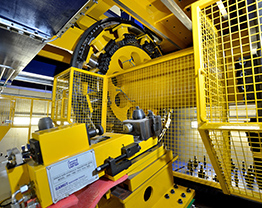
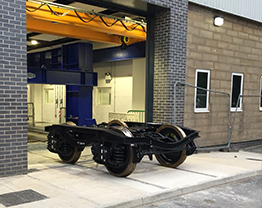
Full-Scale Bogie Rolling Contact, Adhesion and Braking Rig/ Full-Scale High-Performance Test Bench for Pantograph and Catenary Research and Technology Development/ THOMoS: Train Hi-fidelity Motion Simulator / High Performance Computing (HPC) system for Big Data analytics/ Scaled laboratory test rigs/ Track and vehicle measuring equipment/

Research themes

Topic: Vehicle & Track Dynamics
Summary:


Wheel-rail interaction and damage prediction

Train-structure interaction in transition zones and in switches & crossings

Component design and failure mode analysis

Asset life prediction and optimisation

Maintenance planning

Project examples: Shift2Rail: in2Rail / In2Track/EPSRC: Track to the Future / Crossrail intelligent maintenance tool / HS2 track system & WRI performance
Topic: Railway Safety & Risk
Summary:


Risk modelling and & verification of complex systems incl. railway signalling

Level crossing safety risk management

Development of whole-system safety cases

Development of safety management systems for rail safety accreditation

Safety and risk management training

Auditing of safety critical functions

Accident investigation and expert testimony

Emergency preparedness: risk analysis of high-consequence events & development of emergency response procedures

Project examples: T996 Vehicle-Track Categorisation System / Economic Tyre Turning (RSSB Strategic Partnership) / D-RAIL / SET Wheelmotor (Radical Train)
Topic: Data Analysis & Smart Maintenance
Summary:


Big data analytics and machine learning

Condition monitoring systems

Smart maintenance and prognostics

Automated scheduling and planning

Robotics for rolling stock maintenance

Natural language Processing (NLP) for analysis of text records

Project examples: Smart rolling stock maintenance research facility (ERDF) / Data-driven optimisation of wheelset maintenance (EPSRC, Siemens) / Condition based maintenance of locomotive bogies and RCM (S2R) / Big data analytics for point operating machine fault detection (NR)
Topic: Traction, Braking & Energy Systems
Summary:


Traction and braking system research

Wheel-rail adhesion research

Hybrid drivetrain and alternative energy evaluation

Energy recovery system development

Decarbonisation strategy development

Project examples: LABRADOR: low adhesion train braking model development (RSSB) / "LILAC: investigation of the effect of wheel-rail third-body layers on adhesion (RSSB) / Decarbonisation options for rail (RSSB) / Digital displacement pumps for high efficiency drives (RSSB)
Topic: Pantograph & Overhead Systems
Summary:


Contact quality assessment & improvement

Virtual homologation of pantograph-OLE systems

Multiple pantographs in straight & curved tracks

Design of rigid & flexible OLE systems

Dynamic gauging & clearances

Catenary discrete features

Pantograph design & performance

Full-scale test facility for pantograph-OLE dynamics

Sensing systems, sensor calibration, RCM

Project examples: EU: S2R-PantOCL (2018-2020) / PantoCat_NR: Panto-OLE Dynamics Tool (2019-2021) / Panto-OLE Compatibility: Conventional High-Speed (2019-2021) / Design of Novel Pantographs (2020-2021)

Institute of Railway Research – Fact File (2026-27) 

30 Research staff

23 PhD students

210 Publications

Capability matrix

CAPABILITY
CAPABILITY LEVEL
Easy to use for all
Accurate, accessible and understandable real-time information
Smart fare collection
Accessible to all
Multi-modal integrated journeys
Reliable and fast on-board connectivity
Freight friendly
Increased network access for freight
Safer freight operations and better asset management
Enable greater intermodality and access for freight customers
Greater asset utilisation and reduced freight journey times
Low carbon freight and On Track machines
Low emissions
Efficient new electrificaiton
Zero carbon self-powered vehicles
Low carbon freight and On Track machines
Intelligent energy management
Cleaner air
Quieter railway
Lowering embodied carbon of key material
Optimised train operations
Infrastructure and train capabilities to overcome capacity constraints
Simpler and safer real-time operations and decisions
Improved recovery from incidents and disruptions
Reliable and flexible train planning
More affordable solutions for lower-use lines
Efficient and reliable - infrastructure
“Right-time” actionable insights on infrastructure conditions
Efficient, effective and safe infrastructure maintenance
Improved resilience of infrastructure to climate change and extreme weather events
Speed up and de-risk introduction of infrastructure assets
Proactive management of infrastructure obsolescence
Efficient and reliable - rolling stock
“Right-time” actionable insights on rolling stock conditions
Efficient, effective and safe rolling stock maintenance
Improved resilience of rolling stock to climate change and extreme weather events
Speed up and de-risk introduction of rolling stock assets
Proactive management of rolling stock obsolescence
Efficient and reliable - interfaces
Improved vehicle/track interaction
Improved pantograph/overhead line interaction
Improved utilisation of constrained space
Improved whole system resilience
Data driven
Advanced computing
Advanced data analytics techniques
Data governance and standardisation
Data integration
Effective innovation culture
System and network models
Pro-innovation legal and regulatory frameworks
Testing, homologation, cross acceptance
Technically talented workforce
Job design and human performance
Workforce development and training
Safety and health
Safety assessment and evaluation
Cyber security
Fitness for duty and health assessment
Competitiveness
Demand forecasting
Cost modelling
Social value

Research Group key contacts

Name: Paul Allen, Prof, Director of the Institute of Railway Research

Email: p.d.allen@hud.ac.uk

Name: Julian Stow, Principal Industrial Researcher, Department of Engineering
Email: j.m.stow@hud.ac.uk

Website

FIND OUT ABOUT

TESTING AND TRIALING FACILITIES

Facilities