ACADEMIC CAPABILITIES

Nottingham University

Human Factors Research Group


Overview

Human Factors is a field that focuses on the interaction between humans and systems, aiming to improve performance, safety, and user satisfaction by designing systems that accommodate human capabilities and limitations. Core to our research is the application of human centred theories, methods and approaches to tackle contemporary, real world challenges faced by individuals, organisations, communities and societies, across a variety of application domains.

UKRRIN status

UKRRIN member

Member of the Centre of Excellence in Infrastructure (CEI)

Member of the Centre of Excellence in Rolling Stock (CERS)

Human Factors Research Group - Test facilities

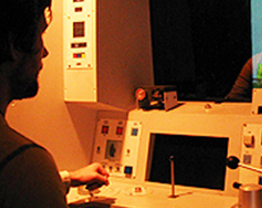
€1.5M immersive transport simulation laboratory ; hi-fidelity train cab simulators ; Usability and Ergonomics Laboratory/

Research themes

Topic: Human Factors
Summary:
The Centre for Rail Human Factors and the Horizon Digital Economy Hub are uniquely placed to help the rail industry improve the customer experience and enhance information provided to passengers, engineers and controllers to help them make the right decisions for their journey, work scheduling and planning. From assisting partners to understand the information needs of end-users through to visualisation of data and personalisation, Nottingham’s experts have a wealth of experience in rail industry research.
Alongside our research on enhancing the customer experience, the Centres work includes areas such as workload assessment, situation awareness, and safety critical communication. The group has access to a rail simulator facility in the University which is augmented by our field based studies. Our expertise in network control, both passenger and public behaviour can be applied to a range of challenges, including driver behaviour and reactions to signalling.
Project examples: ECOTRAX / Human Factors in rail Engineering / Dynamic Light for wayfinding and managing passenger flows at stations / Testing of seat comfort

Human Factors Research GroupFact File (2026-27) 

7 Research staff

10 PhD students

3 Masters student

20 Publications

Capability matrix

CAPABILITY
CAPABILITY LEVEL
Easy to use for all
Accurate, accessible and understandable real-time information
Smart fare collection
Accessible to all
Multi-modal integrated journeys
Reliable and fast on-board connectivity
Freight friendly
Increased network access for freight
Safer freight operations and better asset management
Enable greater intermodality and access for freight customers
Greater asset utilisation and reduced freight journey times
Low carbon freight and On Track machines
Low emissions
Efficient new electrificaiton
Zero carbon self-powered vehicles
Low carbon freight and On Track machines
Intelligent energy management
Cleaner air
Quieter railway
Lowering embodied carbon of key material
Optimised train operations
Infrastructure and train capabilities to overcome capacity constraints
Simpler and safer real-time operations and decisions
Improved recovery from incidents and disruptions
Reliable and flexible train planning
More affordable solutions for lower-use lines
Efficient and reliable - infrastructure
“Right-time” actionable insights on infrastructure conditions
Efficient, effective and safe infrastructure maintenance
Improved resilience of infrastructure to climate change and extreme weather events
Speed up and de-risk introduction of infrastructure assets
Proactive management of infrastructure obsolescence
Efficient and reliable - rolling stock
“Right-time” actionable insights on rolling stock conditions
Efficient, effective and safe rolling stock maintenance
Improved resilience of rolling stock to climate change and extreme weather events
Speed up and de-risk introduction of rolling stock assets
Proactive management of rolling stock obsolescence
Efficient and reliable - interfaces
Improved vehicle/track interaction
Improved pantograph/overhead line interaction
Improved utilisation of constrained space
Improved whole system resilience
Data driven
Advanced computing
Advanced data analytics techniques
Data governance and standardisation
Data integration
Effective innovation culture
System and network models
Pro-innovation legal and regulatory frameworks
Testing, homologation, cross acceptance
Technically talented workforce
Job design and human performance
Workforce development and training
Safety and health
Safety assessment and evaluation
Cyber security
Fitness for duty and health assessment
Competitiveness
Demand forecasting
Cost modelling
Social value

Education and Professional Development

Postgraduate Courses

Human Factors and Ergonomics MSc

PhD opportunities

Yes

Continuing Professional Development (CPD) Courses

Tailored CDP courses by subject, with various lengths.

Research Group key contacts

Name: Brendan Ryan , Associate Professor, Faculty of Engineering
Email: brendan.ryan@nottingham.ac.uk

Website

FIND OUT ABOUT

TESTING AND TRIALING FACILITIES

Facilities